Child Care Aware of New Jersey Mapping Project
Child Care Aware of New Jersey’s child care mapping project allows you to see the various types of child care programs throughout New Jersey. The maps also show Head Start and Early Head Start programs as well as public elementary schools with and without preschool programs.
- Each map can be viewed from a statewide perspective, or you can zoom in to see counties, communities or neighborhoods.
- A legend is available for each map to describe the type of program shown (licensed centers, registered family child care homes, etc.).
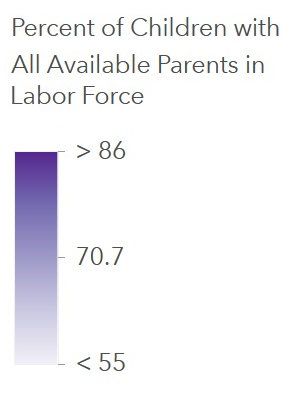
Colored backgrounds. The maps are set to U.S. Census Bureau data that shows children in families where all parents are working. The darker the shade of purple, the greater the percentage of children in working families. This is referred to as a working families layer.
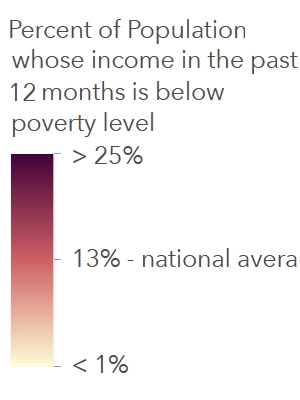
Viewers can also choose a poverty layer. Instead of the purple shading, viewers can select U.S. Census Bureau poverty data, which is reflected by shades of red. The darker the red color, the greater the percentage of children living in poverty.
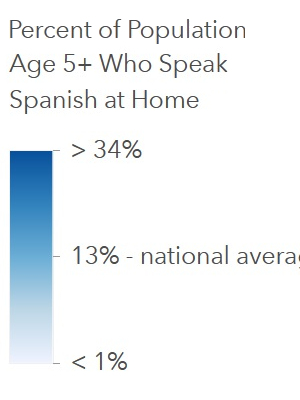
Last, viewers can select a background layer that reflects U.S. Census Bureau data related to children in families where Spanish is spoken at home. The Spanish speaking layer is in blue, with blue shading becoming darker as the percentage of children in families where Spanish is spoken at home increases.

Your view of the interactive maps below can be customized by checking or unchecking the features you would like to see.
These maps are intended for data/research use only. They should not be used to search for child care, as they are not regularly updated. To search for available child care in your area, click here.
Sources. The child care data reflects the operating status for child care programs as of April 2025 from the New Jersey Child Care Information System (NJCCIS). The data related to elementary schools with and without preschool programs is from the New Jersey Department of Education Data & Reports Portal, which shows elementary school data for the 2024-2025 school year.
Mapping Quick Tips:
- Click on the map to open and view the programs in each type of care category
- Zoom in to see counties, communities or neighborhoods
- Click on the symbols/colors in the map to see a pop-up box with program details (program info, census data)
- On the left panel, view the “legend” to see the color coded symbols for types of child care
- On the left panel, click on “content” to check or uncheck various categories (some maps are pre-set – for example, centers serving infants, but you can still uncheck or check items as you wish)
- Children in working families have a purple shade (the darker the purple color, the greater the percentage of children in working families).
- Poverty levels are reflected with various shades of red (the darkest red indicating highest poverty).
- Homes with children where Spanish is spoken in the home are reflect in blue (the darkest blue has the greatest percentage of Spanish speaking homes).
- Map loading time may take a few seconds so be patient!


Child Care Centers Offering Infant & Toddler Care
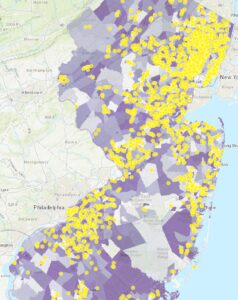
Click here to see child care centers that offer infant and toddler care in New Jersey.
Child Care Centers with School-Aged Child Care Programs
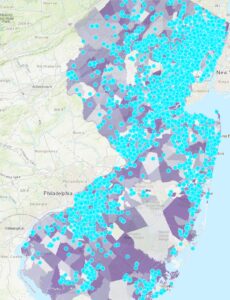
Click here to see child care centers that offer school-age care in New Jersey.
Registered Family Child Care Homes

Click here to see registered family child care homes in New Jersey.
Background Explainer: Children in Working Families, Levels of Poverty, and Children in Families where Spanish is spoken at home.
Head Start and Early Head Start Programs
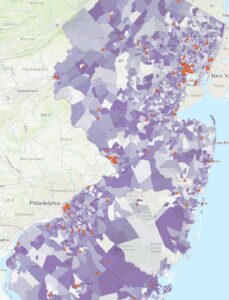
Click here to see Head Start and Early Head Start programs in New Jersey.
Elementary Schools with and without Preschool Programs
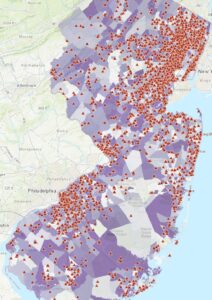
Click here to see elementary schools with and without preschool programs in New Jersey.
Potential Mixed-Delivery Partnerships
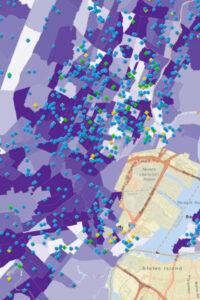
Click here to see elementary schools with and without preschool programs and nearby child care centers. Zoom in to see your community!
Child Care Centers and Registered Family Child Care Homes by Neighborhood Poverty Levels

Click here to see child care centers and registered family child care homes against a background layer showing neighborhood poverty levels.
Child Care Centers and Registered FCC Homes by Neighborhoods where Spanish is Spoken at Home
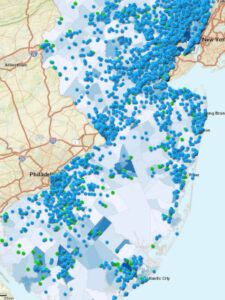
Click here to see child care centers and registered family child care homes against a background layer showing neighborhoods where Spanish is spoken at home.
2023 NJ Home-Based Child Care Businesses (U.S. Census Bureau Economic Survey)
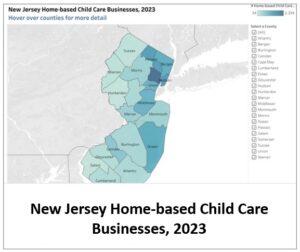
Click here to see NJ’s 13,510 sole proprietors in 2023 who are paid to care for children. In contrast, in April 2025, there were 1,378 registered family child care homes subject to health and safety rules to promote the safety of children in care.
NJ Home-Based Child Care Businesses Statewide, 2012 – 2023 (U.S. Census Bureau Economic Survey)
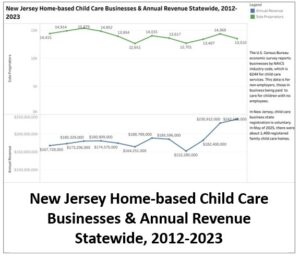
Click here to see NJ’s sole proprietors who claimed earnings from child care services between 2012 – 2023.
NJ Home-Based Child Care Businesses by County, 2012 – 2023 (U.S. Census Bureau Economic Survey)

Click here to see NJ’s sole proprietors by county who claimed earnings from child care services between 2012 – 2023.
Grow New Jersey Kids (GNJK):
All Participating Programs
(April 2025)
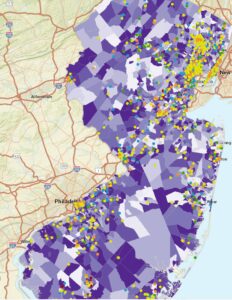
Click here to see all programs participating in Grow New Jersey Kids (GNJK) by rating level.
Grow New Jersey Kids (GNJK):
Child Care Centers
(April 2025)
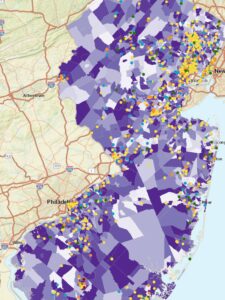
Click here to see child care centers participating in Grow New Jersey Kids (GNJK) by rating level.
Grow New Jersey Kids (GNJK):
Registered Family Child Care Homes (April 2025)
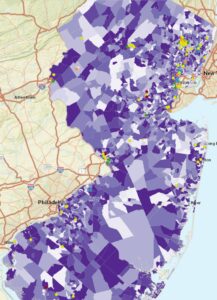
Click here to see Registered Family Child Care Homes participating in Grow New Jersey Kids (GNJK) by rating level.
Licensed Child Care Centers and Registered Family Child Care Homes Participating in CACFP
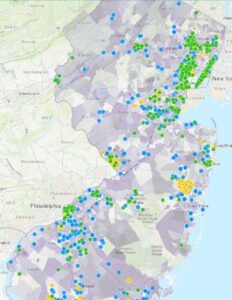
Click here to see licensed child care centers and registered family child care homes participating in the Child and Adult Care Food Program (CACFP).
Why Participating in CACFP Matters!
The Child and Adult Care Food Program (CACFP) is a federal program operated by the U.S. Department of Agriculture that provides reimbursement for nutritious meals and snacks for children in child care.
- Eating nutritious meals and snacks helps support healthy child development.
- Food reimbursement helps providers maximize revenue for their program.
- Children can be introduced to new foods that they may not have had at home (e.g., there are hundreds of recipes in English and Spanish that make cooking fun and offer a variety of foods representative of different cultures throughout the world). Check out U.S.D.A.’s Team Nutrition menu page, multicultural food page, Healthy Kids’ Cookbooks for child care centers, and Healthy Kids’ Cookbooks for family child care homes.
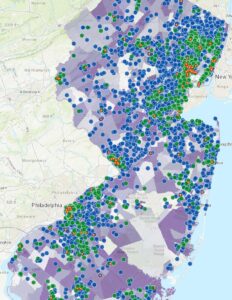
All Child Care Programs
Click here to see all child care programs in New Jersey. It takes a few minutes for all the variables to load. Visitors may want to unclick all the layer options (types of child care) once the map fully loads, and click on each layer you want to add to the map. Zoom in to check out your neighborhood!