
FCC Collaborative Vision
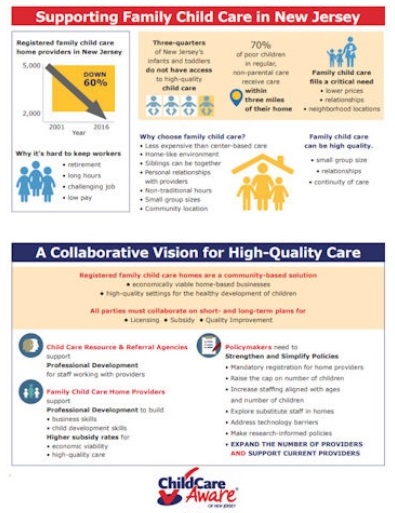
A Collaborative Vision for High-Quality Child Care in New Jersey
Registered family child care homes are a community-based solution
- Economically viable home-based businesses
- High-quality settings for the healthy development of children
All parties must collaborate on short- and long-term plans for
- Licensing, subsidy, and quality improvement
The Vision: High-Quality Child Care in New Jersey
We face a crisis in the declining availability of registered family child care providers in the state. In New Jersey, there were nearly 5,000 registered family child care providers in 2001. That number dropped to 3,000 by 2010 and stood at about 1,200 registered providers in 2022. At the same time, about three-quarters of New Jersey’s infants and toddlers do not have access to a licensed child care center either. These children are somewhere.
What is happening to registered family child care in our neighborhoods?
In focus groups, stakeholders indicate retirement, long hours at a challenging job, dwindling enrollment causing insufficient income, technology, and confusing regulations were contributing to the decline in registered providers. There are major system barriers like low compensation, low payment rates in the subsidy program, the enrollment cap (five children maximum), and inconsistent rules or standards across initiatives. Providers and CCR&R staff also point to day-to-day barriers like the Manual of Regulations and other materials available only in English; challenges with finding and using substitutes; access to computers/electronic devices and access to Internet/wi-fi.
These are problems with solutions.
Throughout 2018, Child Care Aware of New Jersey interviewed stakeholders, surveyed nearly 500 providers responding in both English and Spanish, and brought together CCR&R staff, the Family Child Care Provider Association of New Jersey and individual family child care providers to create an agenda to support and advance family child care. This process revealed some common themes:
- A desire to work together as allies to increase the availability of family child care
- Compensation is a barrier to recruitment (and includes complexities of the cap on enrollment and insufficient payment rates in subsidy)
- Peer support among providers is crucial, as is professional development and peer support for CCR&R staff working with family child care providers
Let’s work together to create solutions for New Jersey.
The recommendations focus on supporting children where they are by supporting their child care providers.
We observe so many allies and potential allies for family child care, and we know that in addition to changing policy, there is a need to change hearts and minds about family child care as well.
There is an opportunity to leverage the research-basis for small group size, relationships, continuity of care, and predictors of quality in family child care. The benefits of family child care may not be widely known to parents, and it is crucial to educate policymakers about how family child care fits into the systems of quality and early learning in New Jersey.
Progress in Strengthening the Quality of Registered Family Child Care Homes to Date
Since 2018, much progress has been made on the journey to ensure high-quality registered family child care homes. While the number of registered homes has been declining, the Department of Human Services, Division of Family Development (DFD) has taken important steps to better support the business of home-based care. For registered family child care providers,
- Subsidy rates per child have increased to a level much closer to market rates
- Subsidy rates per child are now tiered to increased levels related to participation in Grow New Jersey Kids

Child and Adult Care Food Program
The Child and Adult Care Food Program (CACFP) is a federally funded program to support nutritious meals and snacks for children in child care, including registered family child care homes.
Registered family child care homes may be approved to receive reimbursement for serving up to two meals and one snack per day to each eligible child. Learn more about how family child care homes can participate in CACFP!